8 Things You Didn't Know About the Rasmussen University Law Enforcement Program
By Brianna Flavin on 06/29/2017
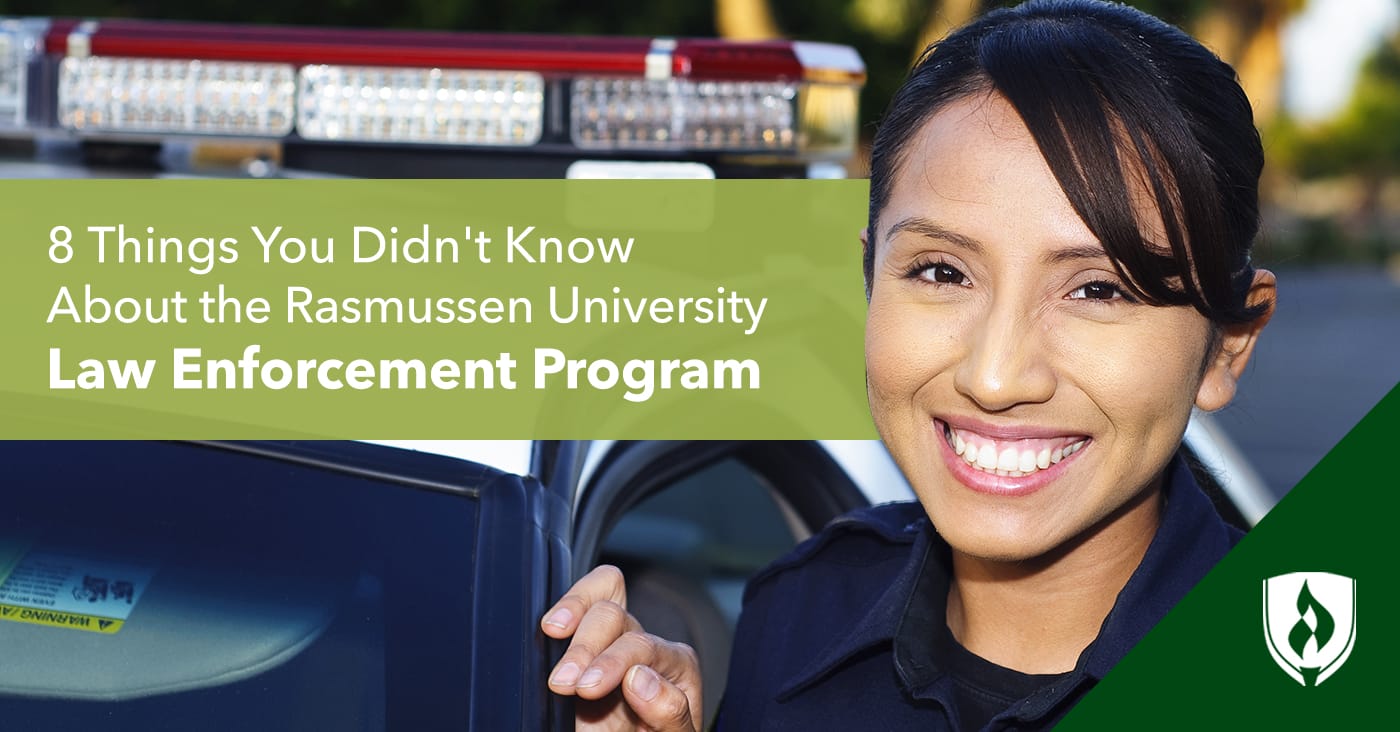
Have you ever wondered what law enforcement school is really like? Graduates need to leave these programs equipped for a career vastly different from your average arts and sciences major.
Do Law Enforcement programs involve driving lessons for high speed chases down the interstate? Do students spend time in lecture halls? Mixed martial arts gyms? Courtrooms? What does their training actually entail?
If you’re considering a career in law enforcement, you’re likely wondering how the path differs from the traditional academic track. Rest assured, these programs are chock full of the interesting and essential training courses law enforcement professionals need to excel in their field.
But not all programs are created equal. Read on to learn more about some of the features that help make the Rasmussen University Law Enforcement program unique.
8 great features of the Rasmussen University Law Enforcement program
1. The Law Enforcement program is Minnesota Board of Peace Officer Standards and Training (POST)-approved
This is perhaps the most important feature of any Law Enforcement program—will it get you where you need to go? Not every Criminal Justice or Law Enforcement program meets the standards set for local law enforcement licensing.
The Law Enforcement program at Rasmussen University does meet this standard—which means graduates are eligible to sit for the State of Minnesota’s Peace Officer Licensing Examination. This is essential for anyone who wants to work as a police officer, sheriff’s deputy, State Patrol officer or in any other Peace Officer role in Minnesota.
2. Students hone their skills at a top-notch training facility
What does a top-quality skills training facility look like in law enforcement? Michael Ardolf, Law Enforcement Coordinator at Rasmussen University, says the Eagan, MN campus’ state-of-the-art skills training facility attracts graduates from other Law Enforcement programs as well as professionals already out in the field.
“Our facility is equipped with multiple situation rooms where students will have to react to various scenarios,” Ardolf explains. These scenarios include volunteers comprised of either current law enforcement professionals or graduates of the program who act as role players in true-to-life law enforcement situations.
“One of our rooms simulates a basic economy apartment,” Ardolf says. “There’s a front and back door, kitchen appliances and other details that might be present when law enforcement is called to a residence.”
Other situational training rooms include a bar, a convenience store and a bank, complete with a teller window and loan document desk. All of this is to teach and eventually test students on the appropriate response to situations they may encounter in the field.
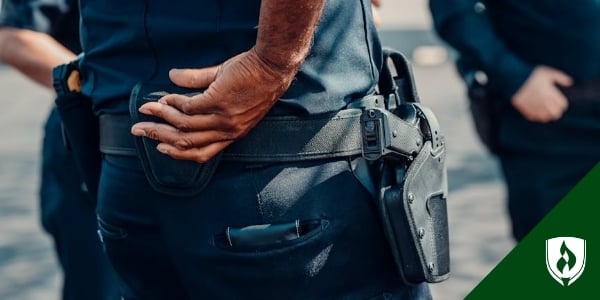
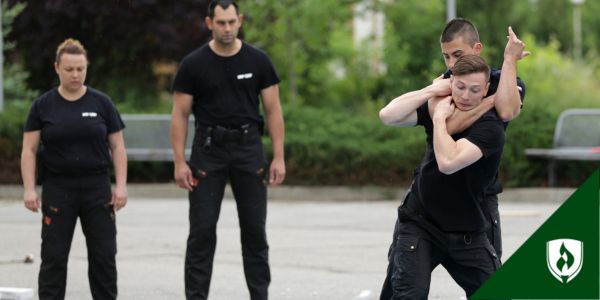
“Our students are trained in all areas of defensive tactics,” Ardolf adds. Some examples include crime-scene response, how to preserve and process evidence, traffic enforcement, radar certification, de-escalation techniques and equipment such as expandable batons and handcuffs. Students also receive training and certification in the use of Tasers, chemical aerosols and firearms.
“You’ll learn how to de-escalate a situation as well as how to correctly and safely use different measures of force when necessary,” Ardolf says.
3. The course includes patrol and high-speed pursuit training
High-speed pursuits are no joke and are notoriously one of the most dangerous situations a law enforcement officer may find themselves in. That being said, Ardolf admits this period of skills training tends to be a favorite of students. They practice pursuit maneuvers on a closed course free of the dangerous variables you’d find on a highway or city street.
"It's not every day you can drive like that without getting into trouble."
“It’s not every day you can drive like that without getting into trouble,” Ardolf says.
Not all of the training is focused on high-octane chases—students also receive rigorous training in everyday patrol duties.
“We have squad cars on campus,” Ardolf explains, “and students will spend time out on the roads with active state troopers who are contracted as instructors, to patrol and achieve radar certification.”
4. Rasmussen University’s law enforcement instructors offer invaluable experience to students
It’s no secret that being a police officer is a demanding job that requires a special set of skills. So who better to teach those skills than the folks who’ve walked the beat for years as law enforcement officers?
“All of our instructors are actively working for, or are very recently retired from, law enforcement agencies,” Ardolf explains. “Many of these instructors are not only the best in their profession, but they also have graduate degrees and are some of the best teachers out there.”
This means that students in the program are being trained and mentored by highly-qualified teachers who have up-to-date experience in the field.
5. The law enforcement program features four start dates per year
One common frustration for many would-be police officers is a lack of timing flexibility found in many training programs. To help alleviate that, the Rasmussen University Law Enforcement program offers four start dates spread out across the calendar year. This gives students more options for completing their training—and prevents lengthy delays in derailing students’ plans.
“Student are surprised to hear that we start a new skills groups four times a year,” Ardolf says, who says most schools only have one per year. “If students fall behind schedule in other programs, they could get stuck waiting nine months before they can enroll in the next skills group.”
6. The program is rigorously kept up-to-date
The MN POST is rolling out new curriculum criteria and objectives in October of 2017, according to Ardolf. Rasmussen University has already been working to accommodate these changes and has developed four new courses to ensure students will be prepared for the MN POST exam and the rigors of the field.
These new courses are:
- CJE 2656 Ethics and Psychology for Law Enforcement Professionals
- CJE 2990 Capstone for Law Enforcement (updated to meet new standards)
- CJE 1775 Special Populations: Law Enforcement Response
- CJE 2422 Communication and Problem-Solving in Law Enforcement
7. Classes are kept small to ensure competency and safety
“Our skills classes are capped at 24,” Ardolf says. “We have a high instructor-to-student ratio for a safe environment and to make sure students understand everything being taught.”
Students in the program are expected to pass testing for firearms qualification, justified levels of force in multiple scenarios, patrol practicals and more. Having a smaller ratio of instructors to students plays a vital role in ensuring that no one gets left behind.
8. The program is catered to busy, working adults
Many students can’t just quit working to complete their education. The Law Enforcement program was designed to accommodate students who have financial and life responsibilities competing for their time. As mentioned earlier, the Law Enforcement program at Rasmussen University offers multiple start dates a year, so you don’t have to wait around for a traditional Fall start.
The skills certificate training is offered on nights and weekends to accommodate a traditional work schedule. What’s more is that the academic parts of the program are offered online to make students’ schedules as customizable as possible. If you want to complete the program, but are worried about how your job or your family might be impacted by your education, these extra options could help make your life much easier.
Ready to get in the action?
If law enforcement training gets you excited, you might have found the right career for you. Law enforcement is always in need of passionate individuals who will thrive in their training, and later excel in the field.
As you can see, the program at Rasmussen University has plenty to offer. But these details only give you a glimpse of what it will really be like. To get more information on timing and costs or to chat with a program representative about other details, check out our Law Enforcement program page.
RELATED ARTICLES: