
Find Out More About:
Professional Nursing (ADN/RN) Program
Associate’s Degree
If the many rewards of being a nurse already have you considering this fulfilling career, our Associate’s degree in Nursing can help you get there efficiently. Take a closer look at why this ADN degree could be the right fit for you and your career path.
Program At a Glance
Program Overview
Professional Nursing: Associate’s Degree in Nursing (ADN)
When you’re looking for ADN nursing programs to become a registered nurse (RN), you’re making the choice to change lives, including your own. You’ll develop the skills you need for a career in caregiving.
In our hybrid Professional Nursing program, we get you on track quickly with:
- No prerequisite coursework for admission
- No waiting list at many campuses for qualified applicants4
- Eight start dates per year at most campuses, while some offer four start dates per year
With a mix of online courses, on-campus lab simulations and clinical experiences in this ADN degree program, you’ll be prepared to sit for the NCLEX-RN® exam and provide compassionate care.5
Already an LPN? With our LPN to RN Bridge, you can advance your education to the next level in as few as 18 months.3
Learn More at a Nursing Information Session
Accreditation

The associate nursing programs at Rasmussen University are accredited by the Accreditation Commission for Education in Nursing (ACEN).
Accreditation Commission for Education in Nursing (ACEN)
3390 Peachtree Road, NE Suite 1400
Atlanta, GA 30326
404-975-5000
Courses
What Types of Nursing Courses Will I Take?
In this Professional Nursing program, you’ll take online and on-campus courses, as well as participate in on-site clinicals. Here are some of the topics you'll cover in this Professional Nursing (ADN) degree program.

Nursing Care of the Older Adult
Examine how personal attitudes and beliefs about aging impact healthcare for older adults. Discover resources that promote autonomy and safety as patients age.
Mental and Behavioral Health Nursing
Explore internal and external factors that impact a patient’s balance and well-being. Study the effects of stress on a patient and their family, as well as the complexities of addressing mental health issues.
Professional Nursing Skills I
Establish the skills to provide basic care and comfort to patients. Learn to care for patients with musculoskeletal, integumentary, and elimination disorders. Practice skills during an on-campus, supervised lab setting.
Leadership & Professional Identity
Examine professional nursing leadership and management responsibilities. Use evidence-based practice to guide decision-making and support clinical judgment to improve patient outcomes. Examine regulatory standards of nursing practice within the legal and ethical underpinnings that improve healthcare.
Total Associate’s Degree Credits
102
Admission Requirements
0
Prerequisite Coursework For Admission
0
Waitlists at Many Campuses for qualified applicants4
0
Cost Application
At Rasmussen University, there is no prerequisite coursework required for admission into the Professional Nursing (ADN/RN) program. At many campuses, there are no wait lists for qualified student applicants.4 With a no-cost application and eight start dates a year for students at most campuses, you can begin your Nursing courses when it's convenient for you.
High school verification documentation may be required.8 Students will need to pass the entrance exam or have a conferred Bachelor’s, Master’s or Doctoral degree with a GPA of 2.25 or higher from an accredited institution of higher learning as recognized by the US Department of Education or by the Council for Higher Education Accreditation. Additional admissions requirements apply, please see the course catalog for details.
Do you want to learn more about the Professional Nursing (ADN/RN) program?
Program Outcomes
What Will I Be Prepared to Do When I’m Done?

Take the NCLEX-RN® 5
Your NCLEX success is our goal. Taught by experienced faculty with vast professional nurse experience, our ADN program prepares you to sit for your national licensure exam and become a confident RN.

Confidently Work in the Nursing Field
Equipped with essential nursing training and employer-focused transferable skills, our ADN Nursing graduates can confidently pursue in-demand registered nurse roles.
Alumni Spotlight
-
Learn more about Rosa's journey:
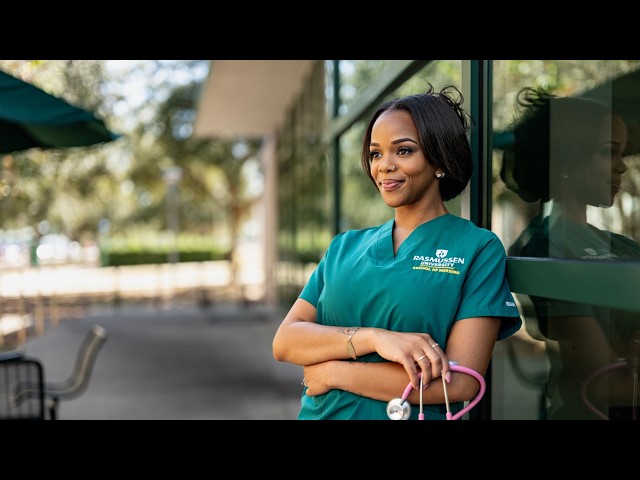
View transcript (Scroll to see full transcript) Rosa S.:
When I think of all that I have overcome, I'm just overwhelmed with gratitude. I just remember the days I didn't know if I would even be alive, or be here to make it to graduation.Shortly after I enrolled at Rasmussen, I was diagnosed with breast cancer.
It was like a bomb had just been dropped in my life. I was just trying to get through nursing school. I had a five year old at the time, and I automatically went into fight mode. It was just terrifying.
I did have to take two medical leaves because I had to have two separate surgeries. I didn't want to come back to school after the second one. I was defeated, not really as hopeful. I was nervous, I was afraid, I didn't think that I would be able to make it to the end.
I reached out to Rasmussen. They immediately were like, Rosa, take what time you need. You can come back when you're ready. I was super grateful with just the amount of support and the amount of reassurance as well.
It's a humbling experience to be the patient, to be helpless, to have to rely on everyone around you, especially when you're normally the caregiver. I had to sit back and allow others to take care of me, and to trust that my care was in good hands. As a nurse, I aim to provide that reassurance in every patient that I come in touch with.
I want them to feel like they can trust me. I want them to feel like I will advocate for them.
Dr. Carrie Daninhirsch, Provost, Rasmussen University:
Welcome to the Rasmussen University 2025 Commencement Ceremony.Rosa S.:
We are cancer free today and we are believing it's going to stay that way. I'm just so grateful for Rasmussen, for all of their support throughout my journey, and for my own village and my family and my support system.Announcer:
Rosa Skinner
[cheers]Rosa S.:
I am still here and I am still pushing and I really have just overcome so much. I am over the moon that my son gets to watch me walk that stage. He pushed me to keep going every day and my husband never let me give up, no matter what it was going to take. And I'm just grateful that my parents are here to witness it, that they're proud of me. And it's just is super special.I'm Rosa Skinner, and I am a proud Rasmussen University graduate.
I am over the moon that my son gets to watch me walk that stage, and that I’m able to be an example for him and show that if mommy did it, you can do it as well.
-
Learn more about Cherish's journey:
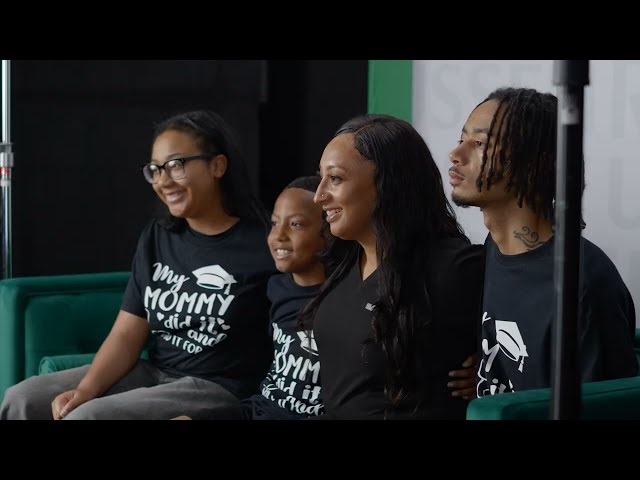
View transcript (Scroll to see full transcript) Cherish:
I was a teen mom. I actually had hid my pregnancy from my family.
One day after school, I ended up going into labor. Alan was born at 34 weeks, so he was six weeks early and he was only 3 pounds, three ounces. So he had to stay in the NICU for about a month.
The nurse who had inspired me, she was just very compassionate and she just really kind of took me under her wing and encouraged me to stay in school and to make something of myself, and just watching how she cared for my son, and then also how she cared for me, really just inspired me. That I really wanted to be able to go out into the world and be able to make a difference in someone's life, the way that she did.
She is really not only just changed my life, but also the legacy that set up for my children as well.
16 years ago I started working as a CNA in the hospital. I loved it. I've worked in areas like the ED, the ICU, so I've gotten a lot of experience.
On the day I decided to enroll in the nursing program at Rasmussen University. It was actually afternoon on my 35th birthday. I was hanging out with a friend, and they just questioned me what I was going to do with this next chapter of my life. I had recently gotten divorced as well, so I was just kind of turning over a new leaf, and I immediately attend. I want to go to nursing school. It's something I've always wanted to do just about between life and things like that. I had a list of reasons like why not to do it at that time. And I said, you know what? What's the worst that can happen?
Without my classmates, I don't know how well I would have gotten through this program. We supported each other because we all knew we had hectic schedules. I constantly had moments where I would have breakdowns and just feel like, I don't know if I can keep doing this, and then I would just keep remembering I was doing this for my kids.
They were what kept me going and helped me to push through. Even when again, I felt like I just wanted to quit.
I am in the first of my family to graduate high school and go on to college, and now becoming a nurse, and it's just honestly been a little humbling as it didn't necessarily happen in the time frame I thought it would, but I think that makes it even more beautiful, because I'm able to kind of look back at this journey and really appreciate it even more. Seeing all the things that I went through to get here.
I want my children to know that they were definitely my biggest inspiration. I am very grateful that I was able to go through this. So now that they can look and see that if mom can go to work and go to school and take care of them and graduate, they can too.
My legacy begins today.
My name is Cherish Adams and I'm a Rasmussen University graduate.
It didn't necessarily happen in the time frame I thought it would, but I think that makes it even more beautiful, because I'm able to look back at this journey and really appreciate it even more.
-
Learn more about Carlos's journey:
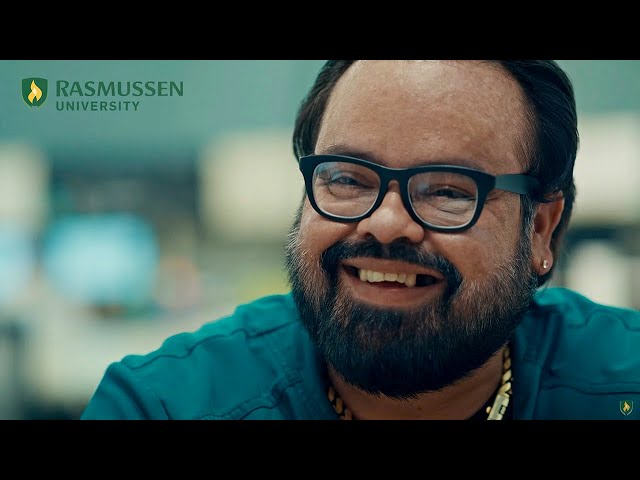
View transcript (Scroll to see full transcript) Speaker 1:
My name is Carlos Salas. I was a salesperson for 22 years; I sold cars, electronic components, and I did loans, mortgages and HELOCs for a financial institution. The reason why I chose to become an RN is because my mother, she spent 30 days in an induced coma to try to fight Covid. Um, unfortunately, she lost the fight to it and passed away. During that time, the staff became part of my support system. Sometimes they would hug me when she was having tough days, and that meant a lot. They didn't know how important it is to have somebody there emotionally to support you.
Speaker 2:
Nursing is a career where you can find meaning and purpose for your life. It's a calling, it's a passion to care for another human being.
Speaker 1:
Rasmussen University has very inclusive and support environment, both the students and the staff. They will ask you what do you need help with? What can I help you with? Every ounce of support that you can get, either from the staff, the faculty or the students is extremely valuable.
Speaker 3:
Our commitment is to those who do go on scene or the ones who feel that they're invisible. We're committed to letting them see or hoping that we can open the door so that they can see that they are too destined for greatness.
Speaker 1:
If you are like me, with a lot of previous experience in a different field, what I can tell you is that it can be done. I have zero nursing experience prior to this, and here we are. I'm four months from graduating. My hope is to work at the ICU department, which is where my mom passed away way. If my mother was alive to see this, to see me become an RN, she would be—sorry.
If my mother was alive to see me become an RN, she would be extremely proud that I was able to accomplish this.
Are you ready to face an extremely challenging and rewarding program?
Speaker 4:
Are you ready for the most amazing career?
Speaker 2:
Are you ready to be a nurse?
I had zero nursing experience prior to this, and here we are four months from graduating. I can tell you that it can be done.
Education Advancement
A Career of Lifelong Learning
If you choose to advance your education beyond ADN/RN, we have Nursing programs and credentials to support your lifelong learning journey, starting with our flexible, online post-licensure RN to BSN and then moving on to MSN and DNP. How far you go is up to you. And by continuing your education at Rasmussen University, you can save time and money in the process as you complete your Associate’s degree in Nursing program.
Associate’s Degree: Nursing (ADN/RN)
Start here if:
You want to become a registered nurse (RN) and are looking for ways to leverage your LPN license, or want RN to be your first nursing credential.
Common Careers:
- Hospitals
- Long-term care facilities
- Rehabilitation centers
- Clinics
Bachelor’s Degree: Nursing (RN to BSN or BSN)
Next step if:
You’re ready to earn your BSN, want to become a Bachelor-prepared registered nurse and are looking for opportunities to advance your career.
Start here if:
You want to begin your nursing career as a BSN-prepared registered nurse. Choose from two pre-licensure entry tracks—standard and second degree.
Time to Complete Degree:
In as few as 33 months: BSN Standard Degree
In as few as 18 months: BSN Second Degree 3
Common Careers:
- Hospitals
- Clinical Practice
- Administration
- Nursing Education
- Nursing Leadership
Graduate Degrees: Nursing (MSN & DNP)
Master of Science in Nursing (MSN)
You are interested in making a positive impact on healthcare and nursing leadership with the choice of three specializations:
- Nursing Leadership and Administration
- Nursing Education
- Healthcare Technology, Simulation and Informatics
Common Careers:
- Director of Nursing
- Director of Education
- Clinical Nursing Informatics Officer
- Chief Nursing Officer
MSN Nurse Practitioner (NP)
You are interested in making a positive impact as a nurse practitioner with the choice of four specializations:
- Adult-Gerontology Primary Care NP
- Family NP
- Pediatric Primary Care NP
- Psychiatric-Mental Health NP
Common Careers:
- Nurse Practitioner
Doctor of Nursing Practice (DNP)
A program for nurses called to at the highest levels in healthcare and public health and policy—the definitive terminal degree for nurse leaders.
Choose the specialization that best aligns with your interests and career goals:
- Executive Leadership
- Public Health and Policy
Common Careers:
- Chief Nursing Officer
- Nursing Administrator
- Director of Public Health and Policy
- Government or Policy Activist
Costs & Savings
Tuition Costs
8
Start Dates a Year
25
Courses
$54,551
Full-Time Estimated Total Tuition and Fees
With eight start dates4 a year at most campuses and a total of 25 courses, full-time Nursing students can finish in as few as 21 months3 for an estimated total tuition and fees of $54,551.
Earning your degree is a valuable investment that needs to fit into your budget. We are committed to providing affordable tuition and breaking down the numbers so you can see how achievable your goals are—and our tuition estimator tool provides you with an idea of your total estimated tuition and fees.
Tuition Per Credit $453
Total Credits x 102
Total Tuition $46,206
Total Fees + $8,345
Full-Time Estimated
Total Tuition and Fees
$54,551*
*This reflects pricing for Florida students. Please speak with an admissions representative or use the tuition estimator tool to calculate your costs.
Need Help Paying for College?
Higher education should be a manageable investment. You’re not alone figuring out how to pay for college. Talk to an admissions representative and learn how our Professional Nursing (ADN) program is designed to be more affordable with transfer credits, self-directed assessments, grants, scholarship opportunities, corporate grants and military grants for those who qualify.


Campuses
Where Can I Find an ADN Program Near Me?
The degree type can vary based on the state. This is an Associate of Science (AS) degree in FL, and an Associate of Applied Science (AAS) degree in MN, IL, KS and WI.
See below to find out where you can find Professional Nursing courses near you.


Kansas City/Overland Park Campus
11600 College Boulevard
Suite 100
Overland Park, KS 66210


Get Started
How to Start Your Nursing Program
Sign Up for a Nursing Information Session
The first step to begin the Professional Nursing program at Rasmussen University is to attend one of our required information sessions.
Complete Admissions Process
Begin Classes on Next Available Start Date
Next Start Date: July 6, 2026
What is a Nursing Information Session?
A Nursing Information Session is an opportunity for you to get a firsthand look at what our Nursing programs and campuses have to offer. Get a closer look at the campus, learn more about the labs equipped with the latest healthcare technology and see how we provide a safe learning environment.
You can speak with a Nursing-specific admissions representative and get a clear picture of your path to becoming a nurse. You'll also have the chance to get your questions answered, start the enrollment process and more.
Nursing Information Sessions will be held virtually unless noted. Upon registering for a session, further details will be shared via email.
Request Info
Ready to Get Started?
As a national leader in nursing education, we have the hands-on curriculum and dedicated support to help you become the compassionate and driven nurse you’re meant to be.

Schedule a Nursing Info Session
Attend an online Nursing Information Session to learn more about Rasmussen Nursing programs and program requirements. You'll also receive information about entrance exam scores, background checks, immunizations, course scheduling and more.

Start Your Application
You can start your application right away at no cost. Your admissions representative will reach out to walk you through the rest of the process and help you start with confidence. You’ll also get financial aid info and answer any additional questions.

Still Have Questions?
You’ll find the support you need to grow as a nurse from mentors and faculty in this program. Our library services, academic support and career planning teams at our Nursing school are ready to help.
Request More Information
Fill out the form for further ADN program details such as program-specific coursework, applying for classes, financial aid (for those who qualify), and customized support.
Related Programs

Online

On Campus
Field Experience
Online
Field Experience
Online
On Campus
Frequently Asked Questions (FAQs)
Have Questions? Look Here.
Q: How do I become an RN?
To practice as a registered nurse, you’ll need to pass the NCLEX-RN®5 national licensure exam. To sit for this exam, you must have successfully completed either an associate degree nursing program or Bachelor’s degree in nursing from a qualified institution in your state.
At Rasmussen University, we offer both BSN and ADN programs in certain markets, providing you with options to pursue the RN degree level that is right for you.
Q: What is the difference between practical and professional nursing?
Practical nursing refers to licensed practical nurses (LPNs) who provide hands-on nursing care, working under the direction of health care providers, such as registered nurses, nurse practitioners, physician assistants and physicians. This can include monitoring patients' health, administering basic health care, reporting patient concerns and updating health care providers’ records. Many LPNs work in assisted living or residential services rather than in hospitals.
Professional associate degree nursing, on the other hand, refers to registered nurses with an associate degree in nursing (ADN) who typically have a greater variety of job opportunities in the work environment. RNs often supervise others and count on their critical thinking skills to perform assessments and make judgments about patient care. Many nurses who complete an associate degree nursing program are more likely to work in hospitals in a variety of roles.
To learn more about the differences, check out our blog post: Practical Nursing vs. Professional Nursing: Understanding the Differences.
Q: What kinds of jobs can I get as an RN?
There are lots of options for you, including roles like:
- Travel nurse
- Pediatric nurse
- Surgical nurse
- ER nurse
- Administration
You might also work in hospitals, clinics or specialty centers.
To learn more about the employment opportunities available, check out our blog post: Top 25 Types of Nurses Employers Are Looking to Hire.
Q: What types of skills will I gain from this program?
Patient Care
Learn patient-centered skills in real-world environments within our nursing school. Prepare to serve in a variety of healthcare settings.Professional Confidence
Classroom and experiential learning build your confidence so you can provide exceptional patient care.Critical Thinking
Develop decision-making skills and care interventions that meet patients’ needs swiftly and calmly.Well-Rounded Perspective
Gain firsthand industry insights from faculty with real-world experience in the nursing profession.
Q: How long does it take to become an RN?
First, you’ll need to complete an associate degree nursing program. The ADN program at Rasmussen University, for example, can be completed in as few as 21 months with the help of transfer credits and $149 self-directed assessments. If you’re already a licensed practical nurse, our LPN to RN Bridge can be completed in as few as 18 months.3
After you graduate, you’ll need to pursue your RN license by passing the NCLEX-RN® 5 national licensure exam.
For more information on nursing education and associate degree nursing plan, check out our blog post: How Long is Nursing School? Your Timeline to Becoming a Nurse.
Q: What kind of support services are available?
At Rasmussen University, we’re here to help. Support services include academic advising, tutoring, financial aid for those who qualify, 24/7 technical support and more. Talk to an admissions representative to learn more about how we'll help you earn your associate degree in nursing.
Q: What does nursing program accreditation mean?
Having accreditation means Rasmussen University has met established quality standards as set by the accrediting body. Achieving accreditation tells the public that an entity meets industry expectations for quality, and students can have confidence that quality control checks have been carried out by a third party.
Q: What are the prerequisite courses to apply for the Professional Nursing (ADN) program?
Unlike many other associate degree nursing programs, there are no prerequisite courses or general education courses in order to apply, and there are no wait lists at many campuses for qualified applicants. You only need to apply once and you can begin your ADN classes on one of eight start dates a year.
Q: ADN vs. BSN: Is there a difference?
Both an associate degree nursing (ADN) program and a Bachelor of Science in Nursing (BSN) lead to the NCLEX-RN licensing exam and a career as a registered nurse (RN).
An associate degree nursing program can be completed in a shorter amount of time and for less money. A BSN is a longer time commitment up front, but results in a higher academic credential and a greater variety of common careers, including in nursing management and leadership roles.
If you choose to earn your Associate Degree in Nursing now, you can still earn a BSN through the online online RN to BSN program.
To learn more about the differences between ADN and BSN, check out our blog post: RN vs. BSN: Is There a Difference?
Don't See Your Question Here?
Our dedicated team of admissions representatives can help you answer questions related to tuition, financial aid, admissions and more.
Speak with an Admissions Representative
Call 833-606-1911
Accreditation Details
Higher Learning Commission (HLC)
Rasmussen University is accredited by the Higher Learning Commission ( hlcommission.org ), an institutional accreditation agency recognized by the U.S. Department of Education.
Accreditation Commission for Education in Nursing (ACEN)
The associate nursing program at Rasmussen University, located at the following campuses, is accredited by ACEN:
The most recent accreditation decision made by the ACEN Board of Commissioners for this associate nursing program is Continuing Accreditation.
- Central Pasco campus, located in Odessa, Florida
- Fort Myers campus, located in Fort Myers, Florida
- Mankato campus, located in Mankato, Minnesota
- Ocala campus (with off-campus instructional sites in Orlando and North Orlando), located in Ocala, Florida
- Overland Park campus (with an off-campus instructional site in Topeka), located in Overland Park, Kansas
- St. Cloud campus, located in St. Cloud, Minnesota
- Tampa/Brandon campus, located in Brandon, Florida
- Wausau campus, located in Wausau, Wisconsin
The associate nursing program at Rasmussen University, located at the following campus, is accredited by ACEN:
The most recent accreditation decision made by the ACEN Board of Commissioners for this associate nursing program is Initial Accreditation.
- Romeoville campus (with off-campus instructional sites in Aurora, Mokena, and Rockford), located in Romeoville, Illinois
Accreditation Commission for Education in Nursing (ACEN)
3390 Peachtree Road NE, Suite 1400
Atlanta, GA 30326
(404) 975-5000
View the public information disclosed by the ACEN regarding these programs at https://www.acenursing.org/search-programs
State Boards of Nursing
The Rasmussen University Professional Nursing Associate's degree in Minnesota, Illinois, Kansas, Florida and Wisconsin is approved by the Minnesota, Illinois, Kansas, Florida and Wisconsin Boards of Nursing.
Illinois Department of Financial and Professional Regulation
The Professional Nursing Associate’s degree program at the Romeoville/Joliet campus in Illinois is approved by the Illinois Department of Financial and Professional Regulation at the recommendation of the Illinois Board of Nursing. The Aurora/Naperville, Mokena/Tinley Park, and Rockford campuses in Illinois are recognized as extension campuses of the Romeoville/Joliet campus.
Minnesota Board of Nursing – Moorhead Campus
The Professional Nursing Associate’s degree program at the Moorhead, Minnesota campus is approved with conditions by the Minnesota Board of Nursing. On June 5, 2025, pursuant to the authority granted under Minn. Stat. 148.251, the Minnesota Board of Nursing issued a Stipulation and Consent for Correction Order imposing conditions upon the approval of the Professional Nursing Associate’s degree program at the Moorhead campus for having an annual pass rate of less than 75 percent on the National Council Licensing Examination (“NCLEX-RN”) of first-time examinees for three consecutive years.
To be removed from conditional approval and restored to full approval, the program must, by December 31, 2025, achieve an NCLEX-RN pass rate higher than 75 percent based on the cumulative results from the four quarters of calendar year 2025 for candidates from the program who write the licensing examination for the first time. If the program does not achieve the requisite pass rate by December 31, 2025, then the program must achieve an NCLEX-RN pass rate of higher than 75 percent by June 30, 2026 based on the cumulative results from the first and second quarters of calendar year 2026 for candidates from the program who write the licensing examination for the first time. If the conditions imposed on the program are not resolved as described herein, then the Minnesota Board of Nursing will follow the procedure outlined in Minn. R. 6301.2360, Subp. 10(C) for uncorrected deficiencies, which may result in the removal of the program from the list of approved programs.