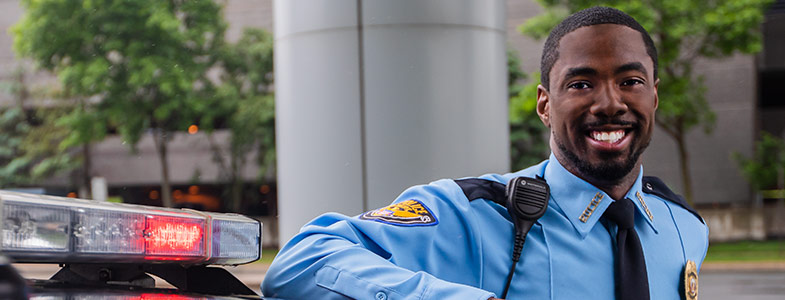
Law Enforcement Associate's degree
The selection standards and training needed to be a police officer in Minnesota are among the highest in the nation. Rasmussen College was the first private college in Minnesota history to be granted state approval for a practical police training program, and our Law Enforcement Associate’s degree will prepare you to meet these requirements through our unique and innovative approach to law enforcement training. You will receive training in realistic settings using the same facilities, equipment, scenarios, and tactics as current law enforcement professionals.
For you, like many of our students, law enforcement is a calling and true dedication to professional public service. By earning our Law Enforcement Associate’s degree, you will be qualified to apply for positions to serve as a law enforcement officer in your community.
Our coursework focuses on real-life scenario training with real-time and practical application of law enforcement tactics. You will hone your skills at a police training facility built for and used by active-duty officers, not at a sterile academic training environment. You will gain extensive firearms experience by firing thousands of rounds of ammunition to develop advanced marksmanship skills and, more importantly, the ingrained muscle memory and the critical-thinking skills you need to make life and death decisions under high-pressure situations.
Using the recommendations of our advisory board of experienced law enforcement professionals, our curriculum also emphasizes the importance of advanced writing and human interaction skills.
Learn more about our Law Enforcement degree and how Rasmussen College is committed to helping you start your path to becoming a police officer. Complete the contact request form on the right or call us at (888) 549-6755, and one of our program managers will be happy to answer all of your questions.
The Law Enforcement AAS degree includes several police-specific courses designed to give you a deeper understanding of key aspects of law enforcement.
Some key courses include:
Firearms I
You will learn the fundamental principles of marksmanship for firearms competency, and will progress to police-specific skills needed for proficiency in firearms use.
Defensive Tactics I
You will learn compliance and control techniques ranging from empty-hand techniques, ground defense, and weapon retention to application of common police officer tools such as handcuffs, chemicals, batons, and electronic control devices.
Police Investigation Process
You will examine the investigation processes for crime scenes and crashes. You will discuss legal issues in crime scene processing, and review basic investigation and reporting forms and the reporting requirements established by statute and policy.
View courses – Law Enforcement Associate’s Courses
View courses – Law Enforcement Certificate Courses
Approved by the Minnesota Peace Officer Standards and Training (MN POST) Board, the Law Enforcement degree program will help prepare you for effective policing in the criminal justice field. The Law Enforcement degree meets the MN POST Board requirements for academic and practical training required to become a licensed peace officer in the State of Minnesota.
Speak with a program manager at (888) 549-6755 to learn more, or you can Request More Information online.
Your instructors (working police professionals) will guide you through the Law Enforcement degree. Your studies will combine important field work, practical training, and networking opportunities with relevant academics for on-the-job success.
Here is a snapshot of some possible careers:
Salary & growth statistics provided by the BLS ‡ |
25th Percentile | 50th Percentile | 75th Percentile | Projected Growth |
| Bailiffs | $26,740 | $37,950 | $53,730 | 8% |
| Correctional Officers and Jailers | $31,210 | $39,050 | $52,240 | 9% |
| Police and Sheriff's Patrol Officers | $40,450 | $53,210 | $67,990 | 9% |
| Transit and Railroad Police | $40,600 | $50,940 | $63,800 | 5% |
Some of the exciting possibilities beyond a fulfilling career as a uniformed police officer patrolling the streets in the interest of public safety include:
The Rasmussen College career placement services staff starts helping you even before you graduate – with your resume, cover letter, interviewing techniques and how to search for a great career. And it doesn’t end there – these services are available throughout your career.
‡"Occupational Employment Statistics Home Page." U.S. Bureau of Labor Statistics. U.S. Department of Labor, 27 July 2010. Web. 27 Sept. 2010.
"Occupational Outlook Handbook, 2010-11 Edition." U.S. Bureau of Labor Statistics. U.S. Department of Labor, Dec. 2009. Web. 29 Nov. 2010.
BLS salary data may not reflect expected entry level earnings.
Transferring your credits doesn't need to be difficult. At Rasmussen College, our transfer policies are designed to maximize your credit transfer and minimize your time to graduation.
Check out some of our highlighted transfer policies below or visit our Transfer Policy for a full description of each policy.
Contact a program manager today at 888-549-6755 or complete the form on the right and one of our program managers will contact you to discuss transferring your college credit to Rasmussen College.
¹ Rasmussen College reserves the right to accept or deny transfer of credits based on guidelines defined in the course catalog. Rasmussen College transfer policies vary by state and degree; contact your local campus to discuss your credit transfer options.
² Refer to the General Education Block Transfer For Baccalaureate Candidates for complete details and restrictions.