-
In-Demand Skills and Industry Certifications
In our online Cyber Security program, you’ll gain key skills using real-world tools, techniques and applications such as cryptography, Windows®, Linux®, Cisco®, VMware®; and Microsoft Azure.2 When teaching comes from those who have years of experience, learning feels vital and relevant. You’ll find immersive online Cyber Security courses led by passionate, industry-experienced instructors.
As you take your Cyber Security courses online, you'll prepare for industry cyber security certification exams, including Systems Security Certified Practitioner (SSCP), Cisco Certified Network Professional (CCNP), Certified Information Systems Auditor (CISA) and CompTIA Cybersecurity Analyst (CySA+). Rasmussen University will reimburse you for up to three exam application fees.3
-
Transferable Skills
Along with cyber security skills, students in all programs and at all credential levels learn employer-valued transferable skills, or soft skills: critical thinking, digital fluency, information literacy, communication, diversity, equity and inclusion, and ethics and professional responsibility.
All skills are strategically embedded into your online Cyber Security Bachelor's degree program, further preparing you for your career. As a Cyber Security student, you'll thoroughly research industry standards in ethics and professional responsibility while completing forensic objectives, ensuring compliance with industry standards. Grow your communication skills as you demonstrate thorough use of audience-specific and influential tone to provide convincing security recommendations, including specific support for your chosen recommendations. Learn more about transferable skills.
-
Self Directed Assessments
Save time and money on your Computer Science Bachelor's Completer degree program with self-directed assessments. These $149 online, interactive assessments allow you to show that you already achieved the skills and knowledge for a particular course and don't need to take it. We'll provide prep materials, and you can work with a peer tutor to prepare at no additional cost. Learn more about self-directed assessments and other Knowledge Credit® options.
-
Institutional Accreditation
Rasmussen University is accredited by the Higher Learning Commission (hlcommission.org), an institutional accreditation agency recognized by the U.S. Department of Education.
Cyber Security
Online Bachelor's Degree
Earning an online Cyber Security degree can help prepare you to enter this specialized area of technology armed with information security knowledge and investigative skills in as few as 18 months.1
Companies in today’s digital economy understand that they can no longer ignore the importance of cyber security oversight. Rasmussen University understands that businesses need people to manage critical information, protect priceless data and be prepared for the unpredictable.
Cyber Security Credentials Offered
Cyber Security
Bachelor's Degree
Finish in as few as
18 months1
Learning includes
- Online
- Campus Support and Resources
Intended for
Students who embrace the role of modern-day forensics and are interested in the challenging role of safeguarding data and information against present-day cyber threats. Also ideal for students with an Associate's degree or previous college credits looking to advance their education and enhance their skills in technology and cyber security.
Prepares you for
Information assurance analyst, information security analyst, information security manager, information systems security analyst, information technology security analyst
Not Sure This Degree Is Right for You?
What Does My Educational Path Look Like?
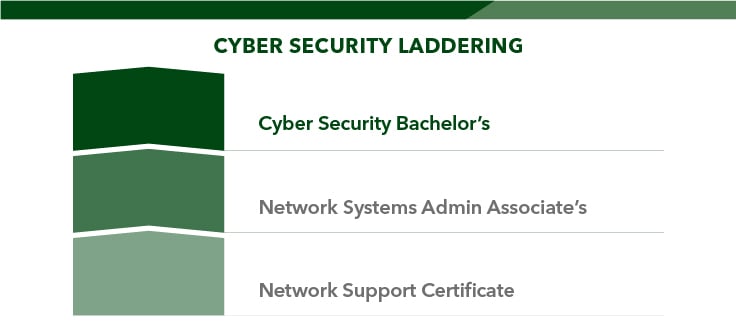
With our laddering approach to curriculum, our Cyber Security programs stack together into one cohesive system. When you graduate from Rasmussen University, you earn more than an online Bachelor’s degree—your degree is a culmination of the credentials before it. Credits simply "ladder-up," one credential to the next, from Network Support Certificate to Network Systems Administration Associate's degree to Cyber Security Bachelor's degree.
Take the Next Step—Talk to Us!
Is a Cyber Security Degree Worth It? The Facts You Can’t Ignore
As our digital reliance grows, it’s no surprise that our digital information is at risk. Find out how an online Cyber Security degree from Rasmussen University can help you play a role in the world of information security.
Read more
Turn Your Online Cyber Security Education into a Career
We’ve made advancing your online Cyber Security Bachelor's degree easier by offering courses that fit into a busy working schedule. You will experience practical, hands-on opportunities in your courses, which will prepare you to succeed in the fields of information and cyber security. If you already have an Associate’s or Bachelor’s degree from an accredited institution, or 60 quarter (or 40 semester) credits, you can transfer those credits and accelerate your online Cyber Security degree timeline.
Here is an overview of your potential career field with an online Bachelor's degree in Cyber Security.
Information Security Analysts
-
BLS Projected Growth 2020–2030: 4
33%
-
BLS Typical Entry-Level Education:
- Bachelor's Degree
"I got hold of a course catalog—Rasmussen was offering unique IT courses I had never seen offered before, and they really interested me."
Jude
Student, School of Technology