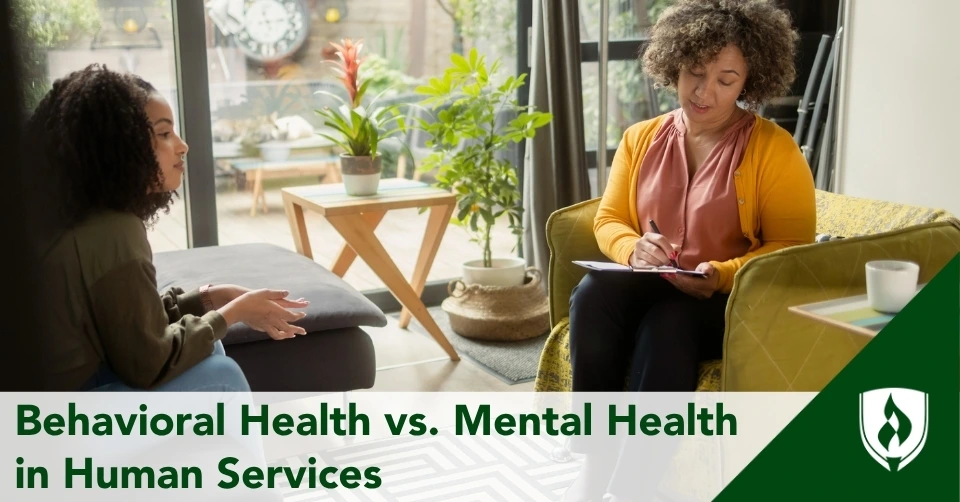
It is natural to wonder why people behave the way they do. Human behavior can be complex, shaped by factors such as family, culture, social environments and individual experiences. For human services professionals, understanding those influences means looking at both behavioral health and mental health.
The terms are closely related, but they are not interchangeable. Behavioral health is a broad concept that includes behaviors and conditions that affect a person’s health and functioning. Mental health focuses more specifically on emotional, psychological and social well-being.
Understanding how the two fields overlap, and where they differ, can help human services professionals better understand the people and situations they encounter.
What is behavioral health?
Behavioral health is an umbrella term that looks at how behaviors, mental health and substance use can affect a person’s overall health and daily functioning.
The National Academies of Sciences, Engineering®, and Medicine reports that 1 in 5 adults, adolescents and youth experienced a behavioral health issue between 2019 and 2020, highlighting how common these concerns can be.1
The Substance Abuse and Mental Health Services Administration (SAMHSA) uses the term behavioral health disorders to include both mental health and substance use disorders.2
More broadly, behavioral health can also include habits, actions and behavior patterns that influence physical health, relationships, work, school and overall well-being.
What can behavioral health include?
Behavioral health can include a wide range of factors that affect how a person feels, functions and cares for their health, such as:
- Mental health conditions
- Substance use and addictive behavior patterns
- Habits related to sleep, nutrition and physical activity
- Behaviors that affect physical health and overall health outcomes
- Patterns of coping with stress or other challenges
Because behavioral health is so broad, concerns may look very different from one person to another.
What are examples of behavioral health concerns?
Behavioral health concerns are often recognized through observable patterns. In educational, family or community settings, for example, someone may notice:
- Persistent inattentiveness
- Impulsivity
- Aggression
- Social withdrawal
- Emotional dysregulation
These behaviors alone do not necessarily indicate a behavioral health disorder. Trained professionals may consider factors such as the frequency, duration and intensity of a behavior, as well as how much it affects a person’s daily functioning. Looking at those factors can help practitioners take a more objective approach rather than relying on assumptions based on a single behavior or incident.
What is mental health?
Mental health focuses on a person’s emotional, psychological and social well-being. According to the Substance Abuse and Mental Health Services Administration (SAMHSA), mental health affects how people think, feel and act, as well as how they handle stress, relate to others and make choices.2
Unlike some observable behaviors, thoughts and emotions may not always be visible to other people. Someone may be struggling with anxiety, sadness or other forms of emotional distress without showing obvious outward signs. This is one reason mental health concerns can sometimes go unnoticed.
Mental health has also historically carried significant stigma, although growing awareness and access to mental health resources have helped encourage more open conversations. When mental health conditions are untreated, they can make it harder to work, keep up with school, maintain relationships, follow daily routines or practice self-care.
What factors can affect mental health?
Mental health can be shaped by many interacting factors rather than one single cause. These may include:
- Biological factors and brain chemistry
- Stress
- Trauma and other life experiences
- Family and social environments
- Substance use
- Physical health
These influences can affect people differently over time. Understanding that complexity is important for human services professionals because a person’s mental health cannot always be understood from outward behavior alone.
What is the difference between behavioral health and mental health?
The main difference between behavioral health and mental health is scope. Mental health focuses on emotional, psychological and social well-being, including how people think, feel and cope with daily life. Behavioral health is a broader umbrella term that can include mental health, substance use and behaviors that affect a person’s physical health, functioning and overall well-being.
One way to think about the distinction is that behavior may sometimes be easier to observe, while thoughts and emotions can remain internal unless a person expresses them. However, the two are closely connected. Mental health can influence behavior, and behavior can affect mental and physical health.
| Behavioral health | Mental health |
|---|---|
| Broader umbrella term | One part of behavioral health |
| Can include mental health, substance use and health-related behaviors | Focuses on emotional, psychological and social well-being |
| May involve observable habits, actions or behavior patterns | May involve thoughts, emotions and experiences that are not outwardly visible |
| Can affect physical health, daily functioning and overall health outcomes | Can affect behavior, relationships, decision-making and daily functioning |
Because behavioral health and mental health overlap, understanding one often requires considering the other. For human services professionals, the distinction is useful without treating the two as completely separate parts of a person’s experience.
Can behavioral health and mental health concerns occur separately?
Can someone have behavioral health concerns without a mental health disorder? Yes. A person may develop habits or behavior patterns that affect their health and daily functioning without having a diagnosed mental illness.
The reverse can also be true. Someone may have a mental health condition without showing readily observable behavioral symptoms. People sometimes internalize emotional distress or become skilled at masking what they are experiencing, which can make concerns harder for others to recognize.
Behavioral health and mental health concerns can also co-occur and influence one another. For example, changes in mental well-being may affect behavior, while ongoing behaviors can influence emotional, psychological or physical health.
For human services professionals, this is an important reminder that observable behavior is only one part of the picture. What a person does may provide useful information, but it does not necessarily reveal what they are thinking, feeling or experiencing internally.
What can behavioral and mental health concerns look like in practice?
Consider a mother who is increasingly concerned about her 13-year-old child’s behavior at home, at school and in the community. During one angry incident, the child throws a game controller and damages it. A few days later, local law enforcement officers find him loitering with friends after curfew. As concerns at school continue, the mother is encouraged to schedule an appointment with a qualified professional.
These behaviors raise important questions. Are they signs of a behavioral health concern, a mental health condition or both? The behaviors have been observed and documented, but they do not provide enough information on their own to answer that question.
Why observation is not the same as diagnosis
One important skill human services professionals develop is distinguishing between what they observe and what they infer. Behaviors can often be directly observed and documented. Thoughts, emotions and motivations usually require further assessment.
In the scenario above, it would be inappropriate to label the child with a behavioral health disorder or mental health condition based only on the reported behaviors. A qualified professional may need to conduct an interview, complete a more holistic evaluation, use formal or informal assessments and consider relevant diagnostic criteria before determining what may be contributing to the behavior.
Behavioral observations are an important part of that process, but they are only one part of the overall picture.
Please note that Rasmussen University’s part of American Public University System (“Rasmussen University”) Human Services Associate’s degree and Human Services Bachelor’s degree programs are not designed to meet, and do not meet, the educational requirements for professional licensure as a therapist, counselor, social worker, psychologist, or other similar licensed careers, in any state.
Why does the difference matter in human services?
Human services professionals may work with people experiencing a wide range of behavioral health disorders, mental health conditions, substance use disorders, trauma and other challenges that affect daily life. Understanding the difference between behavioral health and mental health can help professionals respond to those needs without making assumptions based on one symptom or behavior.
In practice, that understanding can help human services professionals:
- Document observable behaviors clearly and objectively
- Separate what they observe from what they infer
- Recognize when additional assessment, treatment or support may be appropriate
- Communicate more clearly with clients, families and other professionals
- Better understand the role of behavioral health services and mental health resources
Behaviors can provide important information, but thoughts, emotions and motivations often require further assessment. Looking at both behavioral and mental health can help human services professionals develop a fuller understanding of the people they serve and connect them with appropriate support.
Understanding the whole person
Behavioral health and mental health are distinct, but they are deeply connected. For human services professionals, understanding both can help build a more complete picture of what a person may be experiencing.
That means looking beyond a single behavior, symptom or diagnosis. By considering observable actions alongside emotional, psychological and social well-being, professionals can better understand client needs, recognize when additional support may be helpful and approach each person with greater context.
If that is something you care about, you are probably the type of person who wants to help others. There are some incredible ways you can do that with your career. Check out Jobs That Help People: Choosing a Degree for a Fulfilling Career.
National Academies of Sciences, Engineering, and Medicine® is a registered trademark of National Academy of Sciences.
1National Academies Press. (2024). Expanding Behavioral Health Care Workforce Participation in Medicare, Medicaid, and Marketplace Plans. https://www.ncbi.nlm.nih.gov/books/NBK609444/
2Substance Abuse and Mental Health Services Administration. (n.d.). What is Mental Health? U.S. Department of Health and Human Services. Retrieved June 28, 2026, from https://www.samhsa.gov/mental-health