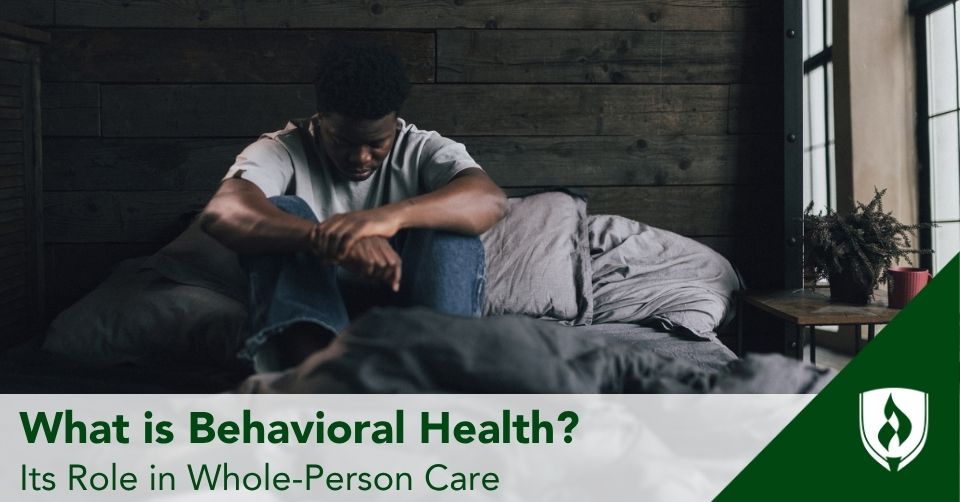
Most people inside and outside of the healthcare industry know what "mental health" means. But behavioral health is a different story.
Nurses, physicians and healthcare workers hear a fair bit about self-care, avoiding burnout and mental health resources (whether they are useful or accessible or not).
And we've been learning more about mental health conditions and needs as an industry over the past decade. But whole-person care goes deeper than that.
Mental health and physical health are both aspects of caring for a person. Afterall, our mental and physical selves exist intertwined.
Behavioral health is an important part of this as well. If you want to work in healthcare, you need to understand how behavioral health impacts each human life—not just for your patients, but for yourself as well. Read on to see how.
What is behavioral health in healthcare?
Behavioral health refers to how humans behave, act and have well-being. The term "behavioral health" is really an umbrella concept, meant to encapsulate the way we can look at the whole person when providing care.
Behavioral health looks at physical health, mental health and emotional health.
Many of us have been through different struggles or challenges throughout life that create who we are and how we perceive ourselves. And since some of the things we go through aren't necessarily just mental, the term "behavioral" is helpful.
Behavioral health care is care that includes:1
- Social determinates of health
- Environmental health
- Mental health wellness
- Mental health conditions
- Medication management
- Substance use
- Suicidal thoughts and behaviors
It is important to understand that behavioral health is not the same as mental health conditions. Rather, behavioral health issues can include mental health conditions among other things that impact a person.
Behavioral health should, ideally, include health specialists and primary care providers, collaborating towards healthy outcomes for patients.
What does behavioral health mean in whole-person care?
Understanding behavioral health is a crucial aspect to looking at whole person care. You can think of it as a process of gaining wellness and a healthy life.
I will break this down into three concepts: behaviors, actions, and well-being.
Behaviors
Think about the behaviors you choose for your health.
What mood do you choose each morning? What routines or habits do you have in place to support your overall well being?
For many, some of these behaviors will include support groups, counseling or therapy, exercise or sleep hygiene, substance abuse education, and other health services like consistent primary care or disease management.
Many mental health and disorder services focus not only on managing a crisis, but also on improving your general quality of life.
Whether you deal with depression, trauma, anxiety, substance use disorder, relationship trouble, anorexia or a binge eating disorder, chronic stress, anger management, PTSD or a host of other mental health conditions--behavioral health services can help you identify barriers and work past them to improve your happiness and quality of life.
This matters for us as healthcare professionals, even beyond understanding our patients.
For example:
- How do you choose to react to different situations?
- Do you let your beliefs and values play a role in the care you provide for patients?
- What biases, assumptions or mental states do you bring to work?
When thinking about care for the whole person, we need to realize that our thoughts, beliefs, and mentality will all reflect the way we practice.
Sometimes, we need to look at our biases and put those aside to provide the best care based on our patient’s beliefs.
For myself, I make an effort to wake up each morning and choose to make the day positive (even when challenges or negativity try to work their way in). I've worked at creating my own values and beliefs to guide me in my practice, and choosing to look for the good in others, even if I need to set a boundary.
Examining and supporting my own behavioral health plays a crucial role in how I provide care.
Actions
A core part of behavioral health is understanding that behaviors, actions and well-being all build on each other.
Our behaviors play a role in our actions--and our actions affect other people as well as ourselves.
When we lead a positive lifestyle and use our values as a basis for our actions, we impact our health all around. If you focus on just one aspect of your body, like heart health or mental health or your size and weight—you can easily lose sight of the interconnectedness of everything. You are an ecosystem, and all parts of you impact each other.
For example, we know that chronic stress from work can cause heart disease.2 Stress might be considered a "mental health" issue, but it affects your entire body, not just your mentality.
Some examples of my actions I use as part of caring for my whole person include:
- Exercising regularly
- Fueling my body with a variety of nutrients
- Communicating with others in a way that builds relationships and works through challenges
- Give positive feedback to others where appropriate
- Continually finding ways to build on my current knowledge
Well-being
Finally, the third concept of behavioral health is well-being.
When we start with our behaviors, then put our behaviors into our actions, we can then work on creating our well-being. Well-being is the state of being happy and healthy.
Well-being includes anything we consider physical, emotional, social, spiritual, and financial.
Each of these begins with our behaviors and actions to become our well-being. Many of us are reminded of Maslow’s hierarchy of needs when thinking about well-being. There are five tiers of needs that must be met to reach the top where you can achieve everything you want.
In my opinion, this is the ultimate goal in how behavioral health affects whole-person care. We need to meet our needs and help our patients meet theirs, until we build up into wellness.
Is behavioral health important for healthcare professionals?
Whether we are in school working on a healthcare degree or we are already practicing in the healthcare field, it is important to look at our own behavioral health and how that influences our role in whole person care.
Think of the behaviors, actions, and well-being we see in our faculty, our preceptors, and our peers. How does that reflect on their roles and the impact they have on our education/careers. What do you need to do to assure that you are taking care of yourself to prepare yourself to take care of others?
Don’t let your past create your future.
Behavioral health can be viewed and perceived in many different ways, but I believe it is profoundly useful as a concept for anyone working in healthcare, not just providers in mental health services.
And for those who are interested in mental health services, it’s useful to know that there are many different work environments where mental and behavioral health services take place. For example, check out 4 Types of Mental Health Nurses (and Where They Work).
1About Behavioral Health, Centers for Disease Control, June 9, 2025, https://www.cdc.gov/mental-health/about/about-behavioral-health.html
2Stress and Heart Health, American Heart Association, Feb 8, 2024 https://www.heart.org/en/healthy-living/healthy-lifestyle/stress-management/stress-and-heart-health