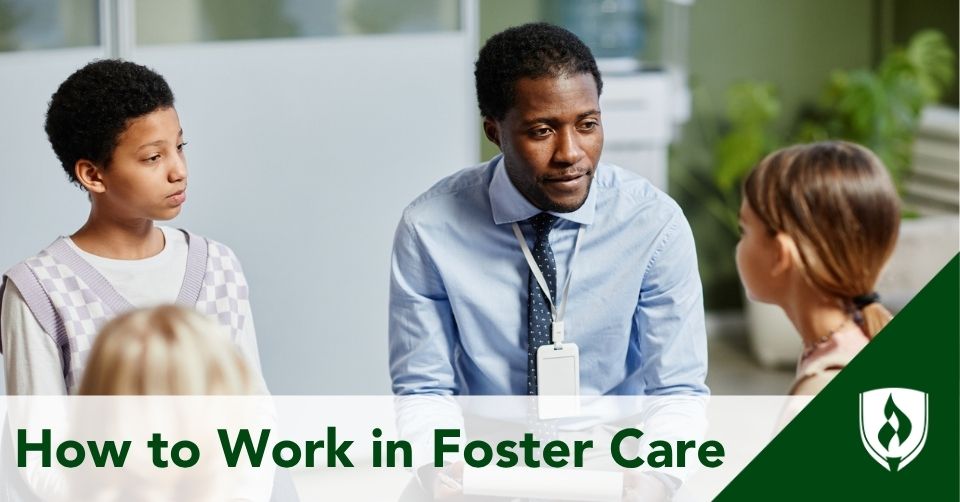
Have you ever wondered how to begin a career in foster care? Or how foster children end up in foster care? Understanding the foster care system may feel complex. At its core, it focuses on helping vulnerable children and families thrive
The foster care system is considered a part of social service programming often employing social workers, social work assistants, case managers, child welfare professionals and more.
What is the foster care system?
As the field of social work developed, the foster care system emerged due the recognition that not all family dynamics help children thrive and that a child's safety needs to be protected.
Historically, children who did not have family who could care for them due to death, poverty, or other issues would end up in an orphanage. Over time, we learned that children do best in families and a system was designed to help all children grow in a family setting. Now, children end up in foster care as a part of the child protective services programming tasked with the responsibility to ensure children are not experiencing abuse or neglect.
How to work in foster care through agencies
There are lots of ways to support children and families in the foster care system. Agencies may be state-run or private.
Private agencies are contracted by the state to help do the work of monitoring cases and providing services. This partnership occurred because private, often religious groups were already doing this work in orphanages. A child welfare agency will employ a variety of individuals from licensed social workers, therapists, caseworkers, care workers, trainers, transporters and clerical staff.
Please note that Rasmussen University’s Human Services Associate’s degree and Human Services Bachelor’s degree programs are not designed and do not meet the educational requirements for professional licensure as a therapist, counselor, social worker, or psychologist, or other similar careers, in any state.
Education requirements for foster care workers
These foster care workers have varied educational backgrounds. While many have a background in human services, other professionals from related fields like education, psychology, and sociology may also apply.1
For example, some foster care worker positions would require a bachelor's degree (like caseworkers or child welfare specialists). Some roles will require a master's degree (such as therapists and management staff.)2
A master's degree may be needed for advancement within an organization.
High school diplomas or associate degrees would fit for individuals who are in support roles, like the professionals who supervise parent visits or help transport kids to and from appointments.
There are also assistant roles in foster work that involve clerical tasks and records management. There are lots of ways to use your strengths and skills in a career as a foster care worker to support biological and foster families.
Working in foster care vs. becoming a foster parent
Foster parents are essential parts of the foster care system. If you want to get involved in this kind of work, it's common to wonder if you want to make it your career—or if you'd rather foster children in your home.
Any individual or family who cares about children and is willing to educate themselves and provide emotional support and meet their needs can be an excellent foster parent.
Foster families come in all shapes and sizes, whether they are single parents or married parents with a combination of biological children, foster children and adoptive children. Foster parents receive special training and resources in areas like behavior management, crisis skills, trauma-informed care, providing support and other aspects of the individualized care plan. Foster families are background-checked and their home is inspected for safety.
They have responsibilities to work with foster care staff to manage school, medical, social, emotional and other needs of the children in foster care. Their role is to work with the case manager and advocate for the child. Key duties of a foster parent include:
- Helping facilitate services like counseling or other programs
- Driving the child to appointments
- Collaborating with providers
- Helping the child implement coping skills they learned in therapy
- Providing a loving and safe environment
- Supporting a child's education and advocating with school staff
The foster parent is compensated for the care of the child, but this is not a paid position. The funds are intended to support the additional needs a child adds to a household.
When there are not enough homes, or a child is struggling with greater needs, a group home placement may be considered. Group homes often provide more therapeutic intervention through individual and group counseling. The child's well-being is the most important consideration for placement.
If you are debating between these two options, consider your ideal extent of involvement. Professionals who work in foster care typically work with many children throughout the week and do set boundaries to ensure they have adequate space and time to balance their own needs and mental health.
People who become foster parents have a more in-depth and one-on-one experience, with the child living in their home for an amount of time that varies from case-to-case.
How the foster system works
The foster system is there to support and protect children who need a caregiver after a disruption that can range from mandated separation after child abuse to the sudden loss of family members.
"Child abuse" is a term that refers to abuse or neglect that children experience, typically at the hands of a caregiver. There are different types of abuse that can be experienced, some individuals only experience one type, others a combination.
Abuse can be physical, resulting in injury. Abuse can also be emotional or psychological. This occurs when the abuser works to make the child feel inferior, worthless, or not important. This type of abuse can also be manipulative, seeking to change the child's behavior to meet the adult's needs or purposes to harm others.
Neglect is a form of abuse. It can be difficult to identify because while a child's basic needs are not met, neglect can happen without any outward signs of mistreatment. At times, neglect happens because a caregiver lacks knowledge or ability to provide care. But at other times, neglect happens because the caregiver lacks access to resources.
While neglect typically relates to not meeting physical or emotional needs, this can also be not meeting educational needs or medical needs.
Children in foster care: How do they get there?
The first step of the child welfare system will be an initial report of concern and follow up research.
Step one: Receiving a report of concern
When someone suspects abuse or neglect, they can and should report this to authorities. Child abuse is a crime and is investigated by child welfare professionals and the police, depending on the circumstances.
This can make reporting difficult since concerned parties worry over setting that chain of events in motion. However, in many circumstances, families need intervention, and the child welfare system can provide the resources to help caregivers protect and support their children. Reunification, when possible, is the goal.
Some professionals, like medical providers, teachers, school counselors and administration clergy, police, fire department, social workers, and other professionals are mandated reporters, who are required by law to report suspected abuse and neglect.
The foster care system is created by a federal mandate but managed by individual states. This means there are minor differences in how foster care works and is managed.
For example, in Illinois, you would contact a state-wide foster care hotline who collects information and then sends it to a local office of investigation. In Wisconsin, you would contact the local foster care office directly. Each state manages their own background checks, training, and protocols.
Ultimately, the goal of providing case management and support to children in foster care is the same. Reports are investigated, and safety is determined. If it is not safe for a child to remain in the current placement, child welfare professionals will remove them.
Step two: Determining what is safest for the child
We now understand that separating a child from their caregivers comes with its own cost in terms of trauma and the psychological impact on the child. Today, many places will make every attempt to keep children with their biological family (or other safe individuals known to the child/ familiar communities.)
When this is not possible, the child is placed with foster parents. At times, a short-term placement may provide temporary relief to maintain safety while building support and identifying resources that might correct the situation.
Step three: Placement and caseworker assignment
Once a child is removed from their home, a foster care social worker or a case manager is assigned to the case to make a plan for treatment and healing. The case manager will also identify community resources to address concerns for the child like mental health, medical health, education and more. For more on that role, check out What Is a Caseworker? One Title, Many Roles.
This worker will also develop an individualized care plan to address the reasons the child was removed from the parent and placed in foster care and address concerns with education, physical health, mental health counseling, substance abuse support and domestic violence services.
Case managers implement the plan and report to court. Court hearings monitor progress and a judge will make a determination on when a child returns home.
Step four: Finding permanence
The goal is for the child to return home.
Child welfare professionals may seek a Guardian Ad Litem (or GAL) to provide advocacy for the child or youth. If progress is not happening within a specified timeline, the case transitions to finding permanency for the child, often through adoption. If a parent has had their rights terminated in the past, this process may look different.
It is best practice for a child to not be in the foster care system indefinitely. Typically, the goal is to return the child to their home within 12 months. This can be extended to about 24 months.
At the two-year mark, case workers and courts might consider a different permanent solution for the child, such as adoption.
Adoptive parents often start out as foster parents. These individuals may have their own biological children or not. Families choose adoption for a variety of reasons, but it is all focused on well-being and care for a family.
Foster care workers are also advocates
The foster care system is one part of a wider social services system. The goal of foster care is to ensure safety while helping children thrive, promote health and develop full lives.
Advocacy is key, as the foster care worker implements programs to provide resources and look out for the child's best interest. This career involves creativity, and dedication to the wellbeing of children and families.
Working in this career can have an immense impact on the lives of both the foster care worker and their clients. If that sounds like something you want from your career, a bachelor's degree in human services might be the first step on your journey.
Foster care professionals play an essential role in supporting children and families during difficult times. This field offers meaningful opportunities to make a lasting impact in communities.
Check out Rasmussen's Online Bachelor's Degree in Human Services page for details on tuition, program timing, courses and more.
This blog is for general informational purposes only and does not constitute advice.
1Rasmussen University does not offer any programs in Education, Psychology, or Sociology
2Rasmussen University does not offer any graduate degree programs that would lead to graduates being eligible to work as a therapist.