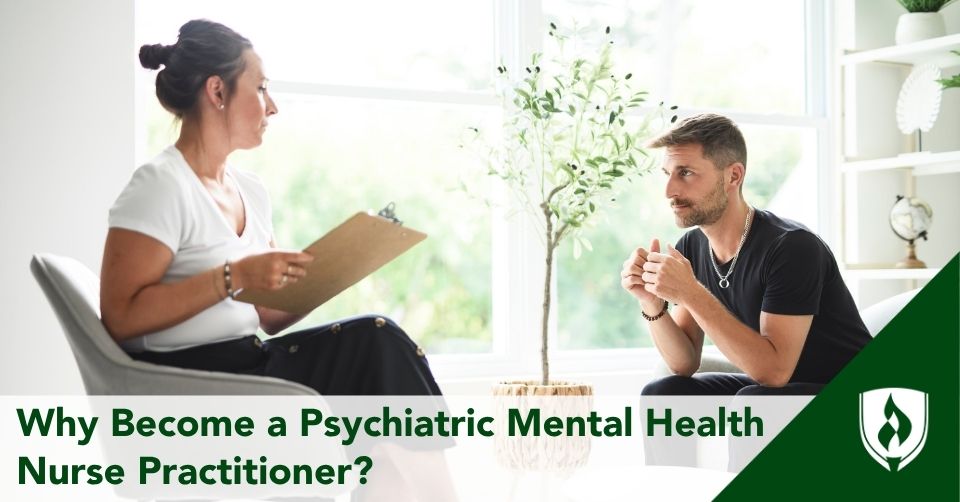
Mental health and behavioral health are big topics of concern in the healthcare industry. Since mental health and physical health are so interconnected, this often means that nurses and other healthcare providers will interact with patients who are navigating mental health concerns—and might be doing so without any help beyond their healthcare visits.
“Mental health nursing, much like mental health treatment itself, is often affected by stigma,” says Rasmussen nursing instructor and PMHNP Allison Carter.
“If you think you might be even slightly interested, give it a chance and keep an open mind.” Carter explains that many prospective nurses and even current nurses rely on other people’s opinions when it comes to what different specialties are like.
“Exploring the field for yourself may challenge those assumptions and open the door to a career you hadn’t previously considered,” Carter explains.
The role of a Psychiatric Mental Health Nurse Practitioner (PMHNP) is very needed in today’s nationwide mental health crisis.1 If you have a heart for behavioral health, you’ve probably considered roles like this more than once.
But finding a career that really works for you and allows you to help people can be tricky. Here are some reasons becoming a PMHNP can be a great choice.
1. We are in a shortage of mental health providers
Substantial shortages of addiction counselors, marriage and family therapists, mental health counselors, psychologists and more are projected in 2038, according to a 2025 HRSA report. They also found that 40% of the U.S. population lived in a Mental Health Professional Shortage Area as of December, 2025.1
With the stigma around mental health help and the shortage of providers to offer it, many people wind up reaching out to their doctor or primary care provider when a mental health crisis hits.
Nearly 1 in 10 adults reported experiencing a mental health crisis in 2025, according to a Health Affairs Scholar report. Out of all those people in crisis, about 72% sought help, and over half of those contacted a doctor, therapist or counselor. In many cases, a person in a mental health crisis sought help from a healthcare facility, instead of places specifically devoted to mental health.2
In fact, organizations like the National Alliance on Mental Illness® (NAMI) direct people in crisis to contact their primary care provider, making an urgent appointment like they would for the flu or an infection—if they don’t already have a mental health professional in their lives.3
2. It’s a great role for nurses who have flexible clinical reasoning
Many things in clinical practice come with clear, cut and dry expectations. Mental health nursing is not like that.
“You need a tolerance for uncertainty,” Carter sats. “Mental health providers must be comfortable working in the ‘gray,’ where information is often incomplete, evolving, or unclear.”
When you are making clinical decisions in this role, you’ll often need to do so without definitive diagnostic tests or straightforward treatment pathways, Carter explains.
“Unlike other areas of medicine, psychiatry rarely offers absolute certainty,” Carter says. “This requires providers to tolerate ambiguity while maintaining thoughtful, flexible clinical reasoning.”
Every nursing specialty offers a different perspective on clinical practice, in one way or another. Palliative care requires nurses to focus on patient experience instead of stopping disease, pediatric care requires nurses to understand the fast, resilient ways children’s bodies heal, and adult-gerontology care requires a lifelong, macro perspective on health.
Mental health nursing requires a curious, adaptable approach to medicine—and professionals who are comfortable guiding patients through things that have no concrete answers. For the right person, it’s a good way to flex those critical and adaptive thinking skills.
3. You are encouraged to nourish your own mental health
Mental health nurses need to be very aware of their own emotional states, communication and well-being. “Exposure to patients’ lived experiences can be impactful and, at times, emotionally taxing,” Carter says.
“Providers must also recognize personal biases or emotional reactions that could influence care, and ensure they are not using their clinical work as a substitute for their own emotional processing.” The ability to recognize potential problem areas and establish supports for your own mental healthcare is not only encouraged, but very necessary at times.
PMHNPs tend to work in places where it’s totally understood that everyone could benefit from therapeutic help. This can benefit you, as a provider, when you have your own needs to see to.
“Seeking appropriate support, including therapy when needed, is an important part of maintaining professional effectiveness and well-being,” Carter says.
4. Nursing programs are very different from medical school
Many people who care about mental health consider other career options, like psychiatry.
That was the case for Carter.
“I am one of those individuals who always knew I wanted to go into behavioral health,” she says. “I can’t recall ever seriously considering another field. That said, I didn’t always envision becoming a PMHNP.”
In her college years, Carter started having doubts about her initial plan to pursue medical school. “I, then, considered becoming a clinical psychologist, as it seemed to align well with my professional goals," she recalls.
But then, in her last year of college she heard a roommate describing an amazing experience she’d had with a mental health nurse practitioner.
“At the time, I didn’t even know PMHNPs existed! But within a few months of learning about the role, I applied to nursing school, and I’ve been incredibly grateful for that decision ever since.”
5. You’ll rely less on the skill of your hands, more on the skill of your intellect
Every nursing role benefits from a great critical thinker. But mental health nurse practitioners tend to have more emotional and intellectual work than other specialties.
"Psychiatric nursing may not involve managing vents, lines, or drains as frequently as medical-surgical settings,” Carter says. “It has different complexities—such as managing acute psychiatric symptoms, safety concerns, and emotionally intensive patient interactions.”
6. There’s more time for deep, emotional care
The compassionate care people receive from nurses of all kinds is kind of a hallmark of healthcare. Nurses are known for being trusted, for this very reason.4
Even so, empathetic nurses often struggle to find enough time to care for their patient’s emotional health the way they really want to.
But as a Psychiatric Mental Health NP, you’ll have more time to listen and work slowly with your patients. “Mental health often requires a deep understanding of a patient’s personal life,” Carter says.
“In mental health care, information is often gathered over multiple appointments that may span weeks or months,” Carter explains. “Patients need time to build trust, and important details frequently emerge gradually.”
Going back to that comfort-with-ambiguity trait, Carter emphasizes that nurses in this role need to also be comfortable meeting patients where they are at, and honoring their process, however slow.
“Progress in treatment is typically slow and not immediately observable,” Carter says. “The trajectory of mental health conditions is often nonlinear and cyclical, with periods of improvement and relapse.”
7. There’s a lot of variety in PMHNP positions
“One of the things I value most about being a psychiatric mental health NP is the variety within the role,” Carter says. “I’ve had the opportunity to work in multiple settings and hold different positions, which has allowed me to avoid burnout and to continually grow and explore different aspects of the field.”
The work settings and employers mental health nurse practitioners can have vary widely—and your choices in these areas will have a big impact on your working schedule and the flexibility you have, Carter explains.
“Factors such as inpatient versus outpatient roles, telehealth versus in-person care, and employer expectations play a large role in determining the flexibility you’ll have.”
For example, Carter met a PMHNP who held a hybrid telehealth and travel position.
For three weeks each month, the provider delivered telehealth services from their home to patients in rural and underserved areas across multiple states, Carter explains.
“During the fourth week, they traveled to Alaska, where they rounded in a hospital setting and conducted in-person outpatient appointments,” Carter says, adding that it was an adventurous kind of role that still allowed the nurse practitioner to offer continuity of care, while also making periodic in-person visits in a high-need region.
8. The impact of your work ripples far and wide
“I really value the impact this work can have,” Carter says. “Even though you’re treating one person, the ripple effect can be huge.”
When you help someone heal and gain mental health skills to support their lifelong balance, you aren’t just helping them—you're impacting every person they love, and whole communities.
“I’ve had patients share that after working together for a few months, their relationships improved and they felt more connected to their families again,” Carter says. “Hearing things like that is incredibly rewarding and a big reminder of why this work matters.”
You may even know from your own experience how much good someone can do when they’ve developed a healthier relationship with themselves. It impacts their children, profoundly. It impacts everyone they work with. And many of the skills and realizations people come to through therapy or psychiatric support will last their entire lives.
If that sounds like something you want to be part of, check out How to Become a Psychiatric-Mental Health Nurse Practitioner: 6 Steps For Future Healers.
1State of the Behavioral Health Workforce, 2025, HRSA, December 2025 https://bhw.hrsa.gov/sites/default/files/bureau-health-workforce/data-research/Behavioral-Health-Workforce-Brief-2025.pdf
2Andrew Anderson, Matthew D Eisenberg, Alene Kennedy-Hendricks, Brian C Castrucci, Sandro Galea, Catherine K Ettman, Mental health crises and help-seeking among US adults in 2024-2025, Health Affairs Scholar, Volume 3, Issue 9, September 2025, qxaf166, https://doi.org/10.1093/haschl/qxaf166
3What to do in a crisis, https://www.nami.org/living-with-a-mental-health-condition/what-to-do-in-a-crisis/
4Nurses Ranked Most Trusted Profession for 24th Consecutive Year https://www.nursingworld.org/news/news-releases/2026-news-releases/nurses-ranked-most-trusted-professionals-for-24th-consecutive-year/
5National Alliance on Mental Illness® is a registered trademark of NAMI National