When people hear “mental health,” they often think of teens or adults. But infants and toddlers have mental health needs too.
In early childhood, mental health is not about labeling kids or looking for problems. It is about everyday well-being. It is about how children feel safe, connect with others, manage big feelings, and explore the world with confidence.
As Dr. Mary Muhs, Ed.D., Dean of the School of Education at Rasmussen University, puts it: “It means their overall well-being, their relationships, their security, connections, and trust with adults.”
What this looks like in real life
For babies and toddlers, mental health support starts with responsive, caring adults.
“Infants and toddlers need to be spoken to kindly, always. They need adults to talk to them and respond to the coos and sounds they make,” says Joni Kuhn, M. Ed., Assistant Professor at Rasmussen University.
When a child is upset or distressed, consistent support helps build trust. Over time, that trust helps children learn self-regulation.
The good news is that ECE (early childhood education) professionals do this kind of support all day long through small moments that build safety and confidence.
Here are six ways ECE professionals care for the mental health and wellbeing of young students.
1. Build safety with warmth and a calm voice
When young children feel safe, they can do what they are built to do: explore, play, connect, and learn. When they do not feel safe, their brain and body focus on protection first, according to Kuhn. That is why an ECE teacher’s voice, face, and body language matter so much, even in quick moments.
“When children feel safe, secure and valued, they can learn better,” Kuhn says. This might sound obvious in principle, but in the everyday chaos of an environment full of little ones, it’s easy to slip into stress and reaction.
“Smile and breathe when talking to a young child or when holding a child,” Muhs explains. “Your calm and affectionate demeanor will help the child regulate their interactions.”
What it looks like in the classroom
This kind of safety is built through small habits that happen all day long.
- Smiling and greeting each child by name
- Getting down to the child’s level when you talk
- Using a calm, gentle voice, especially during stressful moments
- Keeping your facial expression and body language steady when a child is upset
- Responding to infants’ coos and sounds with warm back-and-forth communication
A quick example
Let’s say you notice a child’s voice rising. Instead of correcting him from across the room, by raising your own voice (ex: Danny! Stop that!)--you walk over, get down to his level, make eye contact, and smile softly.
This is far more likely to help Danny start talking about why he is upset, and his big feelings ease before turning into a full meltdown where he is experiencing fight or flight reactions, according to our experts.
Try this
Pick one calm phrase you can use on repeat, like “I’m here” or “We’ll figure it out.” Then use your soft voice early during transitions, before a child escalates. Consistency is often more calming than the “perfect” words.
2. Let the child lead (to build confidence and resilience)
“Let the child lead” can sound like a big idea, and we hear is often in ECE. In practice, it usually starts with one small shift: notice what a child is drawn to, “then follow their cues or interests,” Kuhn explains. When children feel like their choices matter, they start to trust themselves. Over time, trust builds confidence, persistence, and resilience.
Making eye contact with children at their level really applies here as well, Muhs says. It helps each child feel seen and valued.
What it can look like in the classroom
Letting children lead does not mean there are no boundaries. The adult still sets the safe space. The difference is that the child gets room to explore inside it, according to Kuhn.
In an infant room, that might look like “serve and return” moments, when a baby coos or reaches, and the adult responds back with a warm voice or a simple word. For toddlers and preschoolers, it can look like giving choices that both work for you: Do you want to read first or build first?
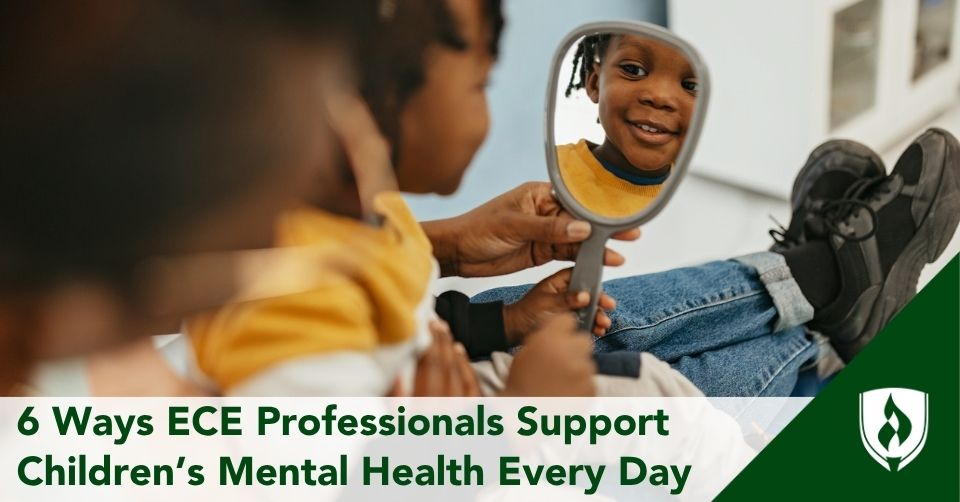
It can also show up in how you set up the environment. If an infant keeps trying to look at themselves, you might add a safe mirror option. If toddlers are fascinated by spinning toys, you might add a few different types. The point is paying attention to what children are already trying to learn through play--and supporting it.
To bring this into your day you can...
- Offer two acceptable choices during common flashpoints, like clean up, centers, or lining up
- Narrate effort, not just results: “You kept trying. That was hard.”
3. Encourage reasonable risks through play
Part of supporting children’s mental health is helping them build confidence. One of the best ways to do that is through reasonable risk.
Reasonable risks are safe, developmentally-appropriate challenges. They are not about being reckless. They are about giving children space to test their bodies, make small decisions, and learn that they can handle challenges.
Risky play can include climbing, balancing, speed, tool use, and rough-and-tumble play when it is supervised and safe. It can also look different by age.
What it can look like in the classroom
For toddlers and preschoolers, reasonable risk often shows up outdoors or during gross motor play, like:
- Letting a toddler try the steps with close supervision
- Supporting climbing or balancing with spotters and clear rules
- Allowing children to test their abilities on playground equipment
- Using specific guidance instead of repeating “Be careful” (“One foot at a time.” “Hold the rail.”)
For infants, it can be as simple as letting them explore textures and movement in a safe space.
Kuhn shares that reasonable risk can look like allowing infants to roll or crawl in an open area where hazards are removed, instead of steering every move. When adults observe instead of controlling, children get to practice early problem-solving, like pausing when something feels unstable.
Why risky play helps mental health
When children get safe chances to stretch themselves, they build coping skills, confidence, and body awareness. They also learn an important lesson: feeling nervous does not mean stop forever. It can mean slow down, try again, or ask for help, Muhs explains.
If you want to support risky play in a practical way:
- Swap “Be careful” for coaching that tells children what to do (“Hold the rail,” “Feet first,” “One at a time”)
- Add one new “challenge option” each week, like a balance path, a small obstacle course, or a new way to climb safely
4. Create predictable routines and calming spaces
Some of the strongest mental health support is also the simplest: help children know what to expect and give them a space that feels calm.
These two pieces work together. Routines reduce stress because the day feels predictable. A calming environment helps children stay regulated enough to handle that day.
Predictable routines help children feel secure
A predictable routine does not have to mean a rigid schedule. It just means the day has a steady rhythm and children are not constantly surprised by what happens next.
That can look like:
- A consistent daily flow (arrival, meals, naps, outdoor time)
- Transition warnings (“Two more minutes, then clean up”)
- Visual schedules for preschool rooms
- Simple transition rituals (a song, a hand squeeze, a “walking feet” chant)
- Narrating care routines with infants and toddlers during diapering, feeding, and handwashing
Routine really means “always telling children what is going to happen before it happens,” Muhs says.
A great example is diaper changes with toddlers. Instead of walking over and picking up a child without warning, a teacher can get on the child’s level, say their name, make eye contact, and share what is coming next.
Then when it is time, the teacher returns, repeats the message, and picks the child up from the front. During the change, the teacher narrates what they are doing and talks with the child. It turns a routine moment into a respectful, connecting moment.
Why it helps
Predictability lowers stress. When children know what comes next, they can focus more on play and learning instead of trying to figure out what is happening to them, according to Muhs. Over time, routines also support emotional regulation because children practice handling transitions in the same safe pattern.
Try this
- Use the same transition cue every day, like a song, timer, or picture card
- Preview changes ahead of time: “Today we will have a fire drill”
Calming spaces support regulation, not punishment
A calming space is not a time-out corner. It is a supportive option children can use to reset. It also includes the feel of the whole room, not just one spot.
That can look like:
- A cozy corner or quiet area children can choose, not a punishment space
- Soft seating, books, sensory items or fidgets when appropriate
- Simple noise and lighting adjustments when possible
- Movement breaks and “heavy work” options (pushing, carrying, helping jobs)
- A classroom setup that reduces crowding and chaos
Make sure the environment is not so busy that it looks like a “rainbow exploded,” laughs Muhs. She also recommends getting down on the floor to see what children see all day long.
Keep the environment clean and organized as well, Kuhn adds.
Why it helps
Some children need quiet to settle. Others need movement. A supportive space helps both. When a classroom feels calmer, children spend less time in survival mode and more time available for learning, relationships, and play.
Try this
- Teach children how to use the cozy space while they are calm, not only when they are upset
- Add one regulation tool that fits your age group, like a sensory bottle, breathing card or quiet music
5. Co-regulate: Name feelings, offer comfort, help kids reset
Young children are still learning how to handle big feelings. Most of the time, they cannot calm down alone yet. That is normal.
This is where co-regulation comes in. Co-regulation is when a trusted adult helps a child settle first, then teaches skills the child can use over time. In other words, children borrow calm from adults until they can build more calm on their own.
Name feelings in the moment
When a child is upset, it can help to name what is happening in a simple, respectful way, according to Muhs.
“You can acknowledge their feelings by describing what you are seeing and hearing,” she says, “Then name their potential emotions.”
That might sound like:
- “I see tears.”
- “I hear a loud voice.”
- “I wonder if you feel mad or frustrated.”
Using “I” statements to separate behavior from identity helps as well, like “I see…” “I hear…” “I feel…” instead of “You are…” This helps children feel understood without feeling labeled.
If you want a simple script to start with, try: “You feel ____. I’m here. We can ____.”
Offer comfort and connection in appropriate ways
Comfort looks different for different children. Some children want a hug. Some want a hand to hold. Some want space but still want you close by.
Support can look like:
- Offering closeness: “Do you want a hug or do you want space?”
- Holding infants, rocking, or gentle patting when welcomed and allowed by program policy
- Staying near a child who does not want touch: “I’ll sit right here.”
It helps to “provide appropriate physical touch with each child, in their preferred way, every day,” Muhs says.
The key words are appropriate and preferred. The goal is connection, not forcing comfort.
Help kids reset with simple coping tools
When children are in big emotions, long explanations usually do not help.
“You cannot talk with a child or have them hear or understand anything you say while they are showing those big emotions,” Muhs says. In those moments, kids often cannot process a lecture. They need help settling down first.
Reset tools can be simple.
- Breathing together or counting
- “Blow out candles” breaths
- Music and rhythm to settle bodies
- Movement resets like wall pushes, animal walks, or stretching
- Reconnecting after the moment: “You’re back. Want to try again?”
One helpful approach is to teach a coping tool during calm times, then use that same tool when a hard moment hits. Over time, children start to recognize the pattern and use the tool with less support.
6. Partner with families and know when extra support is needed
Children do best when the adults in their life are working together. That is why family partnerships are such an important part of supporting children’s mental health.
ECE professionals are in a unique position. They see children in a group setting, across routines, transitions, play, and peer interactions. Families see children at home, in different moments and different environments. “We are doing this together,” Muhs says. “It should always be a ‘we’ and not a ‘you’ conversation.”
When teachers and families share what they notice and stay on the same team, children get more consistent support.
What it can look like
Strong partnerships often sound simple, but they make a big difference:
- Sharing what you notice respectfully (“I’ve noticed transitions are tough lately.”)
- Asking families what works at home
- Creating simple strategies that can work both at home and at school
- Knowing your program’s support options (director, school counselor, early intervention, community resources)
Muhs also recommended sharing positives often, not only concerns. When families hear something good about their child each day, it shows you see their whole child, not just the hard moments.
Why it helps
Consistency builds security. When children get the same kinds of support in more than one place, it can help them feel calmer and more confident. Early support can also help families feel less alone and help children get what they need sooner.
A helpful approach
When a concern does come up, it helps to talk at a time that allows focus. Drop-off and pick-up are often rushed and emotional. Dr. Muhs recommends scheduling a purposeful meeting so everyone can share perspectives and make a plan together.
A strengths-first approach can help the conversation start on the right foot:
- Begin with something the child is doing well
- Ask a collaborative question like, “What have you tried that helps?”
Small moments that make a big difference
Supporting children’s mental health is not about being perfect. It is about showing up with consistency, warmth, and respectful routines, even on the busy days.
The small supports you use every day, like a calm voice, child-led play, predictable transitions, and co-regulation, add up over time. They help children build skills that last, like emotional regulation, confidence, and healthy relationships.
And for many children, an early childhood classroom is one of the first places they learn, “I am safe here. I am seen here. I can grow here.”
That basis can impact their whole lives. It’s worth getting right. Check out Education Experts Share 10 Tips for Dealing with a Difficult Child for more developmental insights in how to support children in your care.
The Early Childhood Education programs at Rasmussen University are not designed to meet, and do not meet, the educational requirements for licensure to teach in public preschools, or kindergarten, elementary, or secondary schools in any state. The Rasmussen University Early Childhood Education programs are not approved by any state agency that licenses teachers. Before enrolling, it is important to understand all of the licensure eligibility standards for a desired career by consulting the appropriate state and school/facility requirements.
This blog is for general informational purposes only and does not constitute advice.